AI applications are booming. Is your business facing compliance and cybersecurity pressure?
Facing compliance pressure from international regulations, client demands, and internal management bottlenecks?
As AI technology becomes more widespread, regulatory efforts are rapidly escalating in various countries, and companies' AI applications are moving from "technical experiments" into the deep waters of "compliance and risk management."
Facing compliance pressure from international regulations:
EU AI Act: The European Commission has launched the "AI Pact," inviting AI providers and deployers to proactively fulfill key obligations of the Act and setting up a help desk to provide support.
US California AI Laws: California has taken the lead by passing several specialized laws (AB-2013, SB-942, SB-53) focusing on training data transparency for generative AI, content watermarking, and mechanisms for reporting safety incidents and whistleblower protection for cutting-edge models.
Taiwan's "AI Basic Act": The Legislative Yuan passed the first AI-specific law on second and third readings in December 2025, stipulating that the Digital Development Ministry will establish a risk classification framework (e.g., customer service robots are low-risk, credit scoring is high-risk), enabling industrial innovation to move beyond a "do first, ask later" gamble towards guided governance standards.
Supply Chain Review Requirements: Customers or international supply chains are beginning to request proof of "safety" and "fairness" for AI systems, and companies urgently need to inventory their internal AI applications and conduct self-risk assessments.
Internal cybersecurity and privacy control gap: Companies are rapidly adopting AI tools but lack unified control mechanisms. Management thinking must evolve from simple "technical training" to a dual-core structure that emphasizes both "compliance and technology."
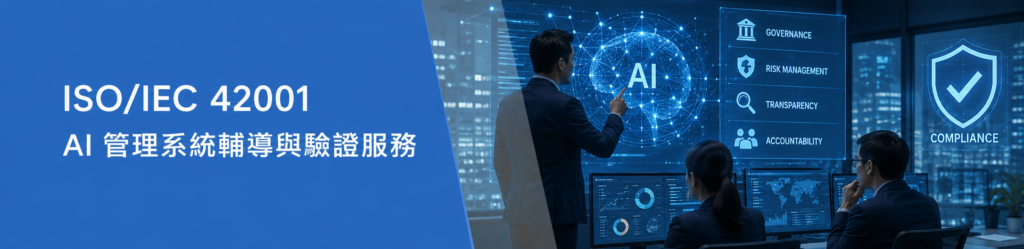
Who is ISO/IEC 42001 applicable to? Which organizations need to implement an AI management system?
AI Product Development/Providers (Generative AI, Recognition Systems, Predictive Models):
For developers or service providers of generative AI, image recognition, voice systems, recommendation engines, predictive models, etc.
Enterprises that deeply apply AI (using AI for resume screening, medical diagnosis, risk assessment):
For example, companies that use AI in scenarios such as resume screening, medical assistance judgment, risk assessment, financial credit granting, customer service automation, and operational decision-making.
Companies facing compliance and supply chain pressures (expanding into overseas markets, bidding for large contracts):
Especially for organizations planning to expand into the European market, bidding on large projects, securing international clients, or requiring responses to supply chain audits.
Mature organization pursuing excellence (already has ISO 27001/9001, wants to complete its AI footprint):
When ISO 27001, ISO 27701, ISO 9001, or other management systems have already been implemented, implementing 42001 can often be more efficient in integrating existing systems. ISO also views 42001 and 27001 as complementary management system combinations.
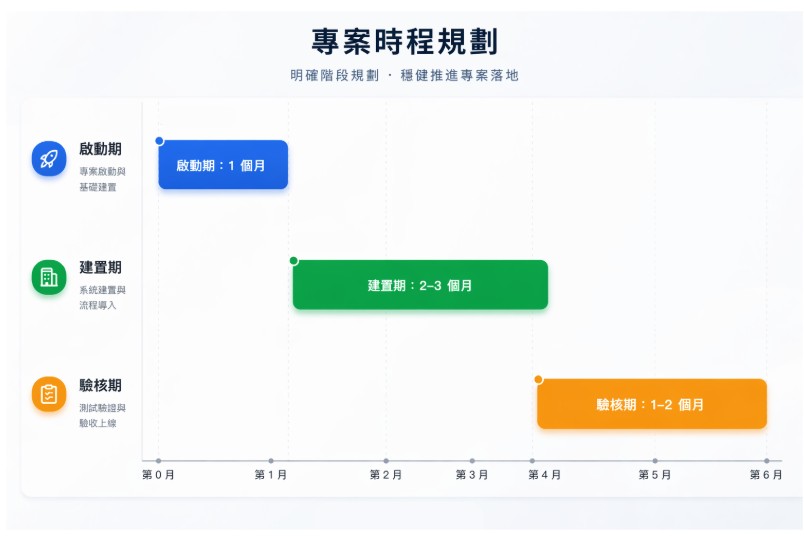
ISO/IEC 42001 Consulting and Certification: A Proven Seven-Step Implementation Solution
Service Steps
- AI Application Deep Dive: Auditing Internal and External AI Systems and Data Flows. Audit internal and external AI systems, use cases, data sources, model outputs, and related data flows to clarify actual managed entities.
- Scope Definition: Precisely delineate managed departments, systems, and locations. Based on organizational structure, operational model, and AI usage scenarios, define the management scope, including departments, information systems, data processing activities, and locations.
- Roles and Responsibilities Assignment: Establish Accountability and Cross-Departmental Collaboration. Define role division, ownership, and cross-departmental collaboration mechanisms within the AI management system, transforming the system from mere documentation into an operational governance framework.
- Risk Assessment and Control: Develop control measures for safety, privacy, fairness, and transparency. FromSafety, privacy, fairness, transparency, traceability, and continuous supervisionConducting risk assessments and developing corresponding control measures. ISO/IEC 42001 itself emphasizes management requirements for AI concerning ethics, transparency, and continuous improvement.
- Integration with existing systems: Seamless integration with ISO 27001 / 27701 to reduce maintenance costs. Integration with existing ISO 27001 / ISO 27701 / ISO 9001 Integrate management architecture to reduce redundant development and subsequent maintenance costs.
- Operations and Internal Audit: Leave an audit trail to ensure effective implementation of the system. Assist in establishing necessary documents, forms, operational records, management reviews, and internal audit mechanisms, leaving behind verifiable evidence trails.
- Verification Audit Support: We assist in preparing for external audits and help you successfully obtain your certification. From pre-audit gap analysis, mock audits, and corrective actions to managing the actual audit, we provide full support to increase your chances of passing on the first attempt.
Flexible Cooperation and Quotation Models
We provide customized implementation plans based on the company's maturity and budget (fees will be assessed based on scale and scope):
- Complete Introduction and Validation: Suitable for businesses that need to build from scratch and obtain external certification (including inventory, construction, internal audits, and mock audits).
- Institutional Gaps and Risk Assessment Suitable for businesses that are waiting to see what happens, or desperately need to respond to specific client/bid requirements, quickly producing risk hotspots and priorities.
- Existing ISO system integration expansion: Suitable for mature organizations with an existing ISMS/PIMS foundation, shortening implementation time.
- Advanced Consensus and Education Training: Suitable for companies that build consensus between management and the promotion team before developing subsequent validation strategies. (Note: Fees will be assessed based on organization size, scope of application, and existing foundation. Please fill out the form to contact us.)
Why choose Mingzheng Management Consulting?
- Advantage 1: Hands-on implementation, refuse to talk theory without action We don't just help businesses "write documents"; we are dedicated to truly integrating AI governance into daily business operations. From scope definition and document structure to record retention, our goal is to ensure processes are practical, operational, and verifiable, so that systems are no longer just superficial efforts to satisfy audits.
- Advantage 2: Seamlessly integrate existing systems, reducing operational and maintenance burden. If your company already has ISO 27001, ISO 27701, or ISO 9001 foundations, it proves extensive system integration experience. This allows for a modular design of systems, significantly reducing the effort of building redundant systems and future maintenance costs.
- Advantage 3: Comprehensive AI Risk Governance Perspective AI risk is more than just "information security." Mingzheng's professional team will guide you in integrating diverse aspects such as privacy protection, algorithmic fairness, decision transparency, accountability, and usage oversight into your overall framework.
- Advantage 4: A "Begin with the End in Mind" Verification and Proctored Service All consulting plans start from "actual needs assessment." We provide precise mock audits and contingency strategies to ensure that companies can easily handle external certification bodies and successfully obtain their certificates.