The new AIAG Core Tools have been officially released independently. Are you ready for your IATF 16949 audit in the face of this wave of AIAG quality tool revisions?
In an environment of rapid global supply chain changes, quality standards in high-end manufacturing are undergoing significant transformations. The AIAG (Automotive Industry Action Group) has recently made substantial revisions to its Core Quality Tools, withThe Control Plan (CP) was also issued independently for the first time.The
Whether you are an automotive supplier preparing for an IATF 16949 audit, or a manufacturer aiming to upgrade from ISO 9001 to aerospace AS9100 to capture the drone market, how can you understand the new standard and transition seamlessly? This article will provide a comprehensive analysis for you.
I. AIAG New Version CP Independently Released: Analyzing the New Version Control Plan's 4 Major Phases and "Safe Launch"
The core purpose of the Control Plan (CP) is to clearly define the control methods and characteristic parameters for a product at each level of the system, subsystem, component, or material. In the major revision of 2024, the original three phases were expanded toFour stagesCompanies should pay particular attention to the following differences when writing CP:
- Prototype
- Definition: Sample manufacturing stage dimensional measurements, material testing, and performance testing.
- Context: The auto parts factory is testing the material strength of a new engine prototype to see if it meets design specifications.
- Pre-launch
- Definition: Tests conducted before mass production, and implementation of enhanced restrictions and controls commence.
- Context: Before mass production of electronic products, validate the performance of the first batch of circuit boards under extreme environmental conditions.
- Safe Launch: This revision's key points:
- Definition: As a supplement to pilot production or formal mass production, implementEnhanced restrictions and regulationsOn the form, you must check both "Trial Production + Safe Production" or "Mass Production + Safe Production".
- Context: Conducting additional crash, extreme temperature, and long-term durability tests for new vehicle models; or subjecting electronic devices to extreme operating tests under high temperature and humidity to ensure there are no safety concerns before official market launch.
- Mass production
- Definition: Standard control plan for entering mass production phase.
II. Key upgrades and updates to APQP: Version 3 strengthens risk mitigation and capacity planning.
The revision of APQP (Advanced Product Quality Planning), in addition to covering the 5 phases and approximately 48 inputs/outputs, alsoAdded 6 key performance indicators.This reflects the risk of supply chain disruptions brought about by geopolitical events and the pandemic in recent years. The standard requires companies to do more than just "bury their heads and work hard"; they must possess the ability to adapt dynamically.
New key inputs and outputs include:
- Initial Quality and JD Power Consumer Reports Early inclusion of market terminal feedback.
- Production Capacity Planning (OEE) and Change Management: Evaluate how to allocate effective production capacity to achieve maximum benefits in environments with material shortages or rapid changes.
Risk Assessment and Mitigation Plan The R&D division needs to establish a backup concept with a second source of supply, enhance independent R&D capabilities, and form strategic alliances. For uncontrollable risks, companies must clearly outline the deployment mechanisms for response teams and war rooms during the APQP phase.
How can companies seamlessly integrate with the major revisions to the AIAG's Five Core Tools?
This AIAG tool revision places greater emphasis on integration with VDA (German Association of the Automotive Industry) and full lifecycle data tracking. The revision status is summarized as follows:
| Core tools | Current Version Status | Revision highlights and differences |
| FMEA | 1st (AIAG-VDA) | Launching a new version in collaboration with VDA. |
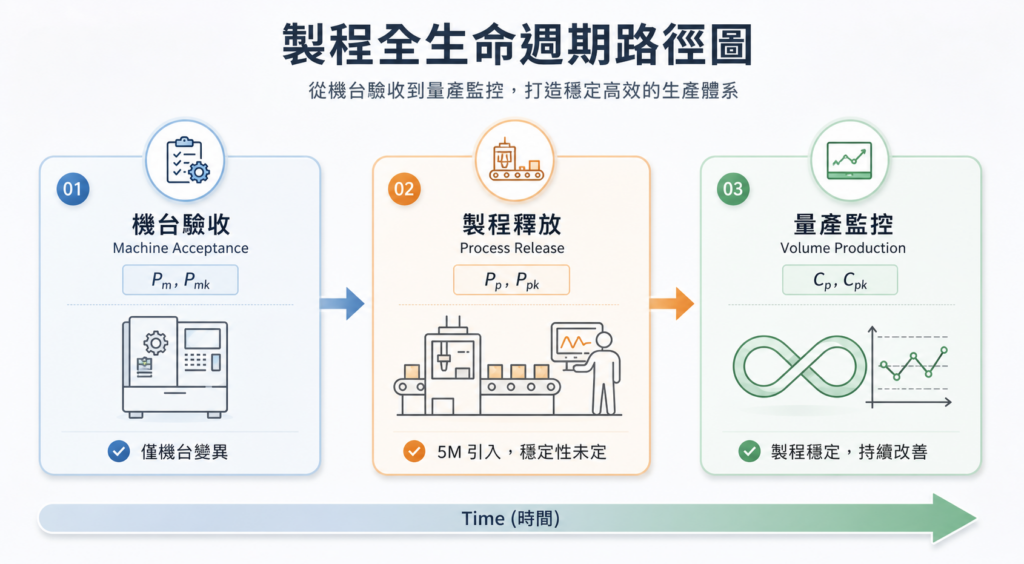
| SPC | 1st (AIAG-VDA) | Introduce the concept of the entire manufacturing process lifecycle.From initial pm/Pmk to pp/Ppk to mass production cp/Cpk. |
| APQP | Upgrade to 3rd | Strengthen production capacity management and supply chain risk mitigation. |
| PPAP | Maintain 4th | Currently remains unchanged. |
| MSA | Maintain 4th | Currently remains unchanged. |
| Control Plan | Independent release | Separated from APQP into its own document, with the addition of the "Safe Launch" phase. |
Common Challenges and Coping Strategies for Businesses Facing New Standards:
When companies face new versions of standards, the biggest challenges are often not in "form format conversion" but rather in the "gap in underlying cognition and theoretical basis."
Many companies fall into the blind spot of "knowing what but not why" when facing new standards:
- Over-reliance on packaged software, neglecting statistical essence: Modern enterprises have largely adopted statistical software such as JMP and ANOVA. In practice, data can be generated with just a button press. However, this leads many to neglect exploring the underlying logic. For example, a common misconception is to treat "control limits" as arbitrarily set values, overlooking that they should be derived from the actual process variation. When the theoretical foundation is not solid, the generated reports will have a significant gap with the actual process capability.
- Core Concept Interpretation Ambiguous: The new standard emphasizes many concepts, but people often get stuck at the cognitive stage. For example: How to understand the specific implementation of "safe production" in CP? How to systematically define "risk" in APQP?
These theories, when dissected, are not difficult. Much like obtaining an IATF external auditor certification, SPC and MSA both focus on assessing underlying theories, which are then further developed. However, if companies try to figure it out on their own, it often incurs significant trial-and-error costs. In such cases, professional instructors can provide guidance, quickly aligning the team's understanding.
From Fail-Safes to System Digitization: Opportunities for Quality Control Upgrades
Past quality thinking was mostly limited to "error prevention (foolproofing)." With the revisions of SPC, APQP, and FMEA, quality control has officially enteredSystematization and digitizationStatistical process control and measurement system analysis in future manufacturing processes will increasingly rely on systematic real-time monitoring of OOC (Out of Control) and OOS (Out of Specification), and utilize a five-factor analysis to ensure absolute process stability.
IV. Mingzheng Management Consulting: Providing Comprehensive IATF16949 Solutions
With the revisions of SPC and APQP, quality control will increasingly rely on the systematic real-time monitoring of OOC (Out of Control) and OOS (Out of Specification). To address the knowledge gap, companies need practical experience that can translate standards into actual benefits.
Mingzheng Management Consultants has extensive experience in IATF 16949 coaching, providing businesses with group training and revision gap analysis. Through systematic education and training, they strengthen the team's fundamental logical understanding, enabling teams to easily handle high-level audits!
Contact Mingzheng Management Consultants immediately to help your business bridge the final gap in entering the high-end manufacturing supply chain!
One-stop solution provider