The World Economic Forum will publish a global risk report in 2023, gathering 1,200 experts to assess 34 risks and provide in-depth analysis of these possibilities and impacts. Among the top ten risks in the long term (in the next 10 years), 6 are directly related to the climate environment.
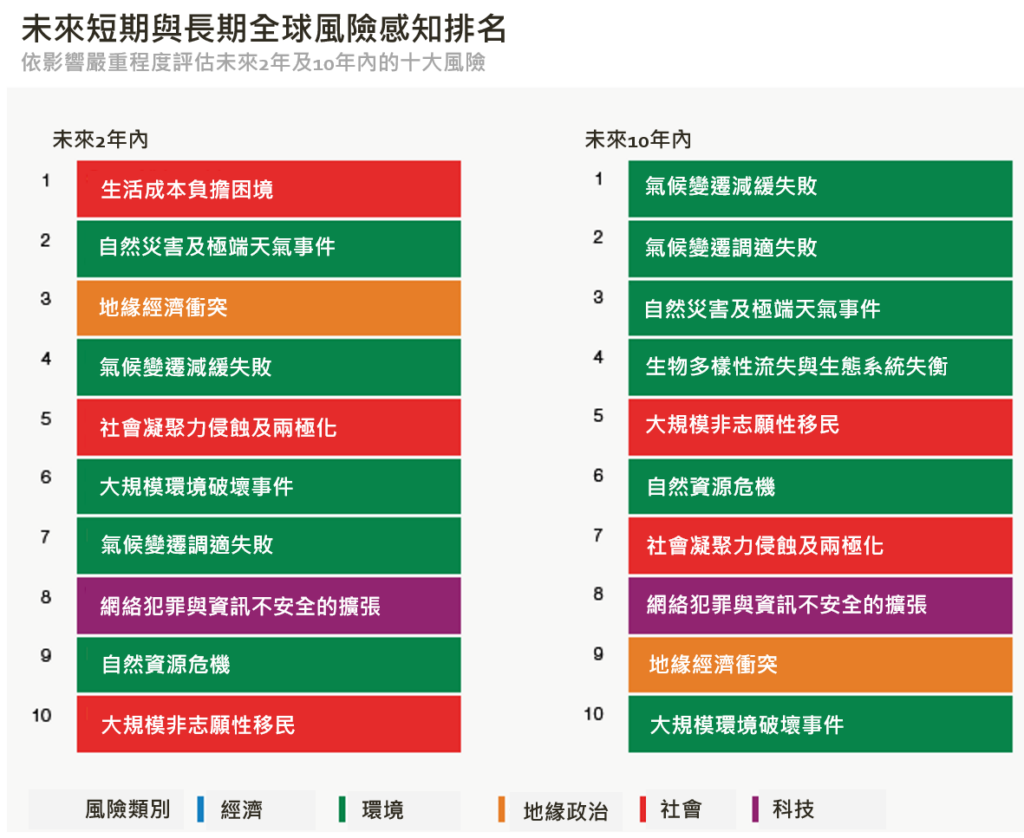
Source: World Economic Forum (2023)
1. International greenhouse gas reduction practices and regulations:
- The European Emissions Trading System (EU ETS) is one of the major climate policies launched by the European Union
Since its implementation in 2005, it has become one of the largest and most successful carbon emissions trading systems in the world. The emissions trading model of the EU ETS encourages companies to compete at lower carbon emission levels while providing economic incentives to achieve the EU's greenhouse gas emission reduction targets. The European carbon market is constantly adjusting and is regarded as a reference model for carbon markets in other regions around the world, with a demonstration effect.
- The Carbon Border Tax (CBAM) is a carbon border adjustment mechanism launched by the European Union to prevent carbon leakage and promote clean industries.
CBAM requires purchase vouchers for high-carbon-emission products imported into the EU to ensure that their production complies with EU carbon emission standards and prevent companies from transferring high-carbon-emission products to non-EU countries with looser environmental policies, causing carbon leakage. CBAM has been put into trial operation in 2023 and will be officially collected in 2027.
- The U.S. Carbon Tariff (CCA), known as the Clean Competition Act, is designed to punish manufacturers of carbon-intensive products.
The implementation of CCA will be based on the average carbon content of U.S. products, and carbon fees will be levied on both imported products and U.S. products whose carbon content exceeds the benchmark. CCA is expected to be officially launched in 2024.
Take a European manufacturing company’s participation in EU ETS as an example:
- Companies are allocated carbon emission quotas, and if they can reduce emissions within the quotas, they can sell them to other companies at a profit.
- Excessive emissions require the purchase of additional credits or investment in emission reduction, otherwise they will face fines.
2. What is ISO14064-1?
ISO14064-1 is a standard developed by the International Standards Organization (ISO) that focuses on greenhouse gas (GHG) monitoring and reporting by organizations. The standard provides guidance for organizations to establish a complete greenhouse gas management system to ensure accurate tracking, monitoring and reporting of their carbon emissions.
How does ISO14064-1 affect a business or organization?
- Establish a greenhouse gas management system: By complying with ISO 14064-1, companies can establish a complete greenhouse gas management system to effectively track, monitor and manage their emissions.
- Risk management: Through regular measurement and reporting, organizations can better identify their carbon footprint and then develop emission reduction strategies to reduce carbon risks.
- Market competitiveness: Open and transparent carbon reporting helps enhance a company's social responsibility image. Environmentally friendly corporate images are more popular in the market and improve competitiveness.
ISO14064-1 application cases:
- Walmart uses ISO 14064-1 to measure supply chain carbon emissions to help formulate sustainable business strategies.
- Microsoft implements ISO 14064-1 to achieve carbon neutrality goals and has an environmentally friendly image.
- Ford Motor Company uses ISO 14064-1 to monitor greenhouse gas emissions during the production process to improve its ecological footprint.
3. What is ISO14067?
ISO14067 is an international standard on carbon footprint, providing a framework for assessing greenhouse gas emissions throughout the entire life cycle of a product; including raw material collection, manufacturing, transportation, use and processing stages. Through carbon footprint assessment, organizations and businesses can understand the impact of products on the environment and take steps to reduce their carbon footprint. ISO14067 is different from ISO14064-1, which focuses more on the organization's overall greenhouse gas monitoring and reporting.
ISO14067 application cases:
A manufacturing company might use ISO 14067 to calculate the carbon footprint of its products and optimize production processes to reduce emissions, while using ISO 14064-1 to monitor the company's carbon emissions overall.
In the current business environment that emphasizes environmental sustainability, applying for ISO 14064-1 and ISO 14067 is crucial.
- Urgency to apply for ISO 14064-1:
- Compliance and regulatory requirements, following ISO 14064-1 is a critical step in ensuring that an organization adheres to relevant regulatory and environmental requirements.
- Consequences of not applying: Failure to comply with regulations may result in additional costs, fines, etc., as well as an increased risk of business losses and reputational damage.
- Urgency to apply for ISO 14067:
- To fully understand the impact of products, applying for ISO 14067 enables companies to fully understand the carbon footprint of their products and optimize production and supply chains.
- The consequences of not applying: loss of market opportunities, increased supply chain opacity, and difficulty in detecting potential environmental risks.
Overall, these two standards are important tools for companies to proactively address climate change, helping to enhance their environmental image, comply with regulations, and remain competitive in a highly competitive market.
One-stop solution provider