

IATF 16949:2016 Quality Management System for the Automotive Industry Consulting to Help Businesses Obtain Certification
Essential Certification for Entering the International Automotive Supply Chain
What is IATF 16949?
What is IATF 16949?IATF16949:2016 is a global standard for industrial quality management systems in the automotive industry, developed under the auspices of IATF and ISO.The objective is to develop automotive quality management system standards that are consistent along the automotive supply chain.
Which organizations support and require suppliers to obtain the IATF 16949:2016 certificate?
The IATF members include the following nine major Automotive Assembly Plant (OEMs):
BMW Group, Daimler AG, Ford Motor Company, General Motors, Groupe Renault, Jaguar Land Rover (JLR) Limited,
Stellantis (ex FCA), Stellantis (ex PSA), Volkswagen AG
Additionally, there are five major automotive manufacturer associations:
AIAG (U.S.), ANFIA (Italy), FIEV (France), SMMT (U.K.) and VDA (Germany)
These automotive manufacturers support and require their suppliers to obtain the IATF 16949:2016 certification.
Who needs to obtain IATF 16949:2016 certification?
If your clients include those on the list above, they must obtain the IATF 16949:2016 certification. This standard specifically targets the automotive industry, covering product design/new product development, manufacturing, and installation services. It is generally encouraged for the entire automotive supply chain, including related assembly plants, to hold the IATF 16949:2016 certification.
Even if suppliers are members of the IATF (most Japanese suppliers are members of the Japan Automobile Manufacturers Association, not the IATF), without a valid IATF 16949:2016 certification, it is unlikely they can supply to Tier 1 suppliers or have the opportunity to supply to automobile manufacturers as suppliers.
What are the differences between IATF 16949 and TS 16949?
Originally known as ISO/TS 16949, IATF 16949:2016 was a technical specification of the International Organization for Standardization (ISO). Its aim was to develop a quality system—a system capable of ongoing improvement within the vehicle supply chain and among manufacturers, with a focus on defect prevention, reduction of variance, and waste elimination.
Based on the ISO 9000 standards, the first version, ISO/TS 16949:1999, was released in June 1999. This standard was established by the International Automotive Task Force (IATF) along with ISO’s “Technical Committee” to integrate various national quality management system requirements.
In 2016, the IATF issued IATF 16949:2016, replacing the older ISO/TS 16949:2009. This update allowed IATF 16949 to be certified within the automotive industry supply chain, with the certification based on the IATF’s published certification rules.
Explanation of the IATF 16949:2016
The new standard, IATF 16949:2016, was released by the IATF in October 2016, replacing the existing ISO/TS 16949 which outlined Quality Management System (QMS) requirements for the automotive industry.
The new standard aligns with ISO 9001:2015. IATF 16949:2016 is not an independent quality management standard but is based on ISO 9001:2015, supplemented with additional requirements specific to the automotive industry.
The objectives of the IATF 16949:2016 revision are: 1. Emphasis on defect prevention 2. Reduction of variation and waste 3. Continuous improvement 4. Inclusion of specific automotive industry requirements and tools.
IATF 16949:2016 places significant emphasis on the “process approach”, “customer orientation”, and “zero defects” requirements.
The standard aims for businesses to focus on meeting customer needs and increasing customer value as the starting point of their operations. It highlights the importance of understanding customers’ purchasing power, preferences, and behaviors through analysis, emphasizing the innovation in product development and marketing strategies to dynamically adapt to customer demands.
“Customer orientation” represents a mindset that centers around the customer. Historically, businesses originated from new technologies and products, operating with a “Product-Centric” mindset (a perspective still maintained by many companies). The primary goal was to develop new products and technologies. However, the risk of a product-centric approach is market insensitivity, producing products that do not meet market needs, leading to significant resources being invested in new technologies that consumers do not accept. In contrast, a “Customer-Centric” approach means that all company operations revolve around meeting customer needs, with product development focusing not on pursuing high technology but on genuinely meeting consumer demands.
What is the validity period of the IATF 16949:2016 certificate?
The IATF 16949:2016 certification is valid for three years, and during this period, an audit must be conducted at least once every year.
These audits can be performed by IATF-certified auditors (third-party auditors) or by certification bodies approved by the IATF.
After three years, the certification needs to be renewed.

IATF 16949:2016Key points:How much does it cost to implement IATF?
The costs for Consulting and auditing depend on the size and scale of the organization, as they are calculated based on the number of consulting days and auditing days required.
For example, for a small business with about 20 employees, needs may include the provision of document templates and the implementation of coaching training courses.
Estimated Coaching Costs: Approximately NT$250,000 to NT$500,000, subject to adjustment based on an actual face-to-face consultation and site visit.
AIAG’s five core tool manuals are divided into:
1. Advanced Product Quality Planning (APQP)
2. Failure Mode and Effects Analysis (FMEA). This failure mode impact analysis was integrated with VDA in 2017 to produce the AIAG-VDA standard, which was jointly published by AIAG and VDA as AIAG-VDA FMEA
3. Measurement System Analysis (MSA), relevant guidelines for calibration of measurement equipment
4. Statistical Process Control (SPC), analysis methods of statistical data and related guidelines
5. Production Part Approval Process (PPAP), approval criteria for products or services in the production process
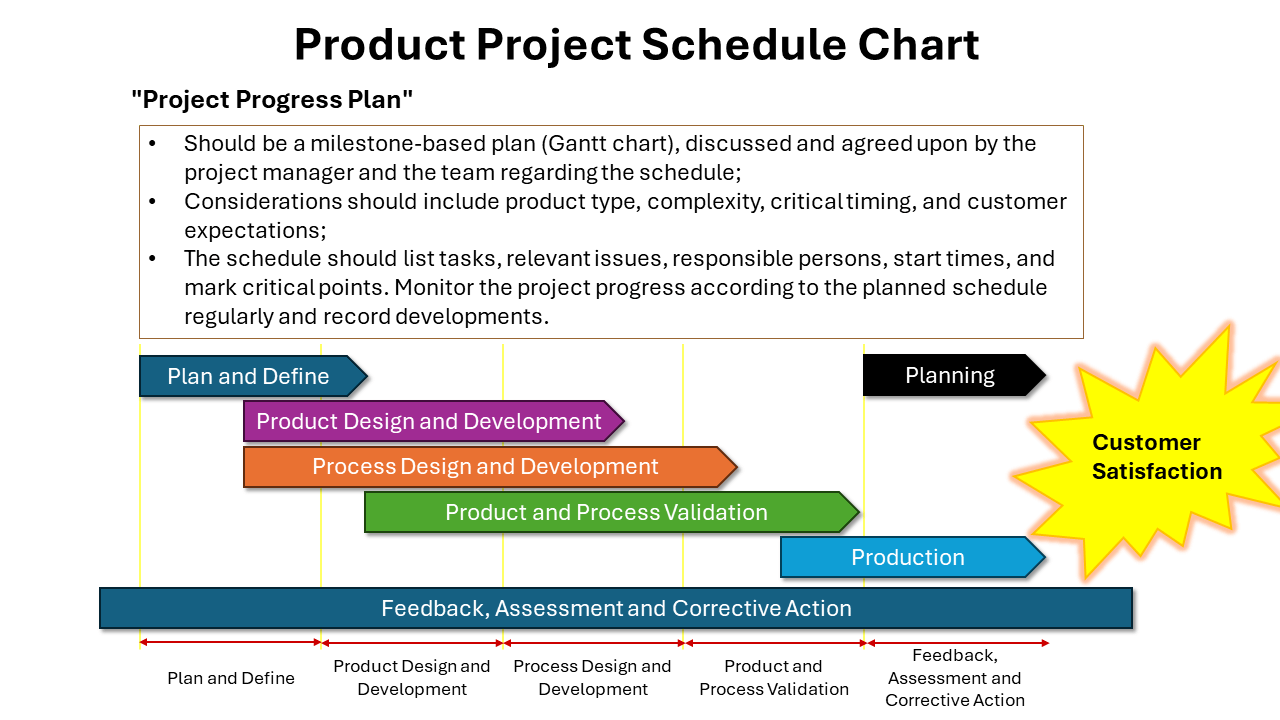
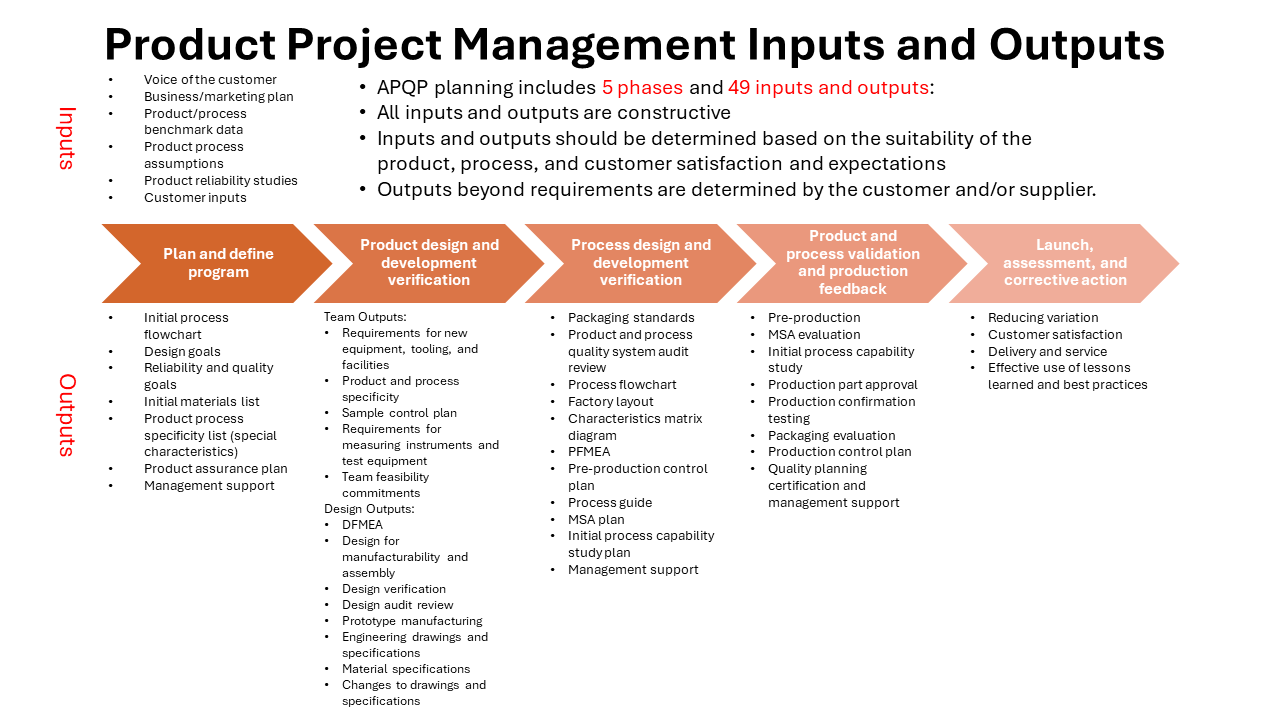
The progress of the project plan is shown in the figure below, and the corresponding inputs and outputs are also displayed simultaneously, and these five core tools are interspersed, fully interpreting the provisions of IATF16949 (Read more:Interpretation of IATF16949 provisions) should implement relevant methods and tools for project management.
IATF 16949:2016Key points:How is six sigma implemented?
Six standard deviations, also known as six sigma (its symbol is "σ", pronounced "Sigma"). Tools and procedures for process improvement. In the automobile industry, "zero defects" has always been the ultimate goal of the automobile manufacturing industry and related customers. To achieve these goals, including zero defective escape from testing, zero repeated problems, zero customer product disconnections, and zero claims, some tools and methods are needed to assist.
Of course, it does not necessarily mean that there must be no problems or defects in the manufacturing process. Instead, many control methods or analytical techniques are used to achieve early prevention and advance planning, reduce failures and defects from problems or various optimization processes, solve customer and own problems, and move towards the goal of zero defects.
In other words, companies that strive to implement six standard deviations have relatively reduced variability, increased value, lowered costs, reduced waste and shortened cycle times, thereby bringing high-quality products and services to customers, even exceeding customer expectations.
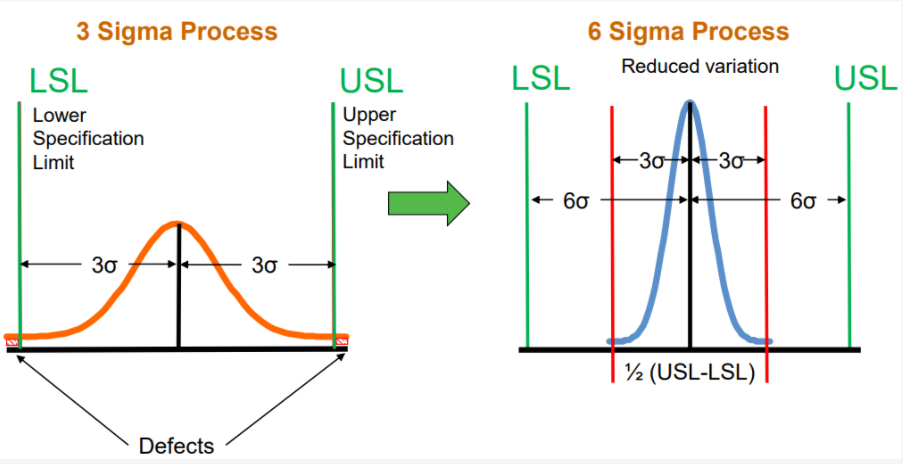
The definition of six standard deviations is to use statistical methods to model the statistical data in the process, such as the normal distribution curve and reach six standard deviations between the process mean and the nearest specification limit. When the variation of the manufacturing process is controlled through various controls and improvements, the characteristics or functions of the product fall within six standard deviations. 99.99966% of the products have no quality problems (3.4 defects per million). Therefore, six standard deviations can be used to calculate the percentage of defect-free products in the product.
Simply put, Six Sigma means that 99.99966% of the products produced have no quality problems (3.4 defects per million).
The concept of Six Sigma was born at Motorola in the 1970s, and has been combined with a variety of tools to strengthen this core idea, such as total quality production management (TPM), zero-defect methods, quality control, DMAIC methods, DMADV or DFSS methods, and of course various auxiliary quality management tools to jointly move towards this core goal. For example, measurement system analysis (MSA), statistical process control (SPC), Why-Why analysis, variance analysis, ANOVA analysis, fishbone diagram analysis, DOE, Plato analysis, quality function deployment (QFD), regression analysis, SIPOC analysis, Taguchi analysis, etc.
Recently, due to Toyota's lean production method - the core is to create maximum value with minimum work, the 1984 Production Philosophy (TPS) aims to reduce useless waste in the production process. Therefore, some people combine the Six Sigma method with the Lean production method and establish a management method called "Lean Six Sigma".
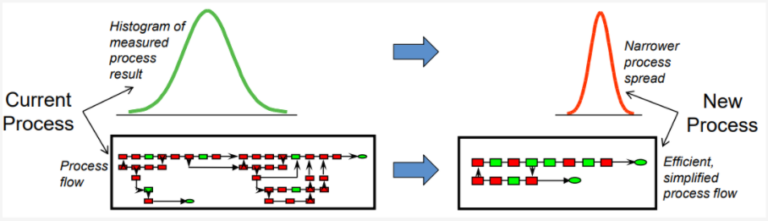
For simple six standard deviation or six standard deviation cases, you can learn from Honeywell, GE, the world's top 500 companiesYou can get a glimpse of it,mostWell-known enterprisesThey have already started to use Six Sigma management methods to reduce costs and improve management quality.
For example, the restaurant can control the meal delivery time as much as possible within the required time range to meet the customer's need to enjoy a hot meal within the specified time;Apparel industry maintenanceThe size of the clothes should be made in the same size as possible., so that customers can measure their body shape and clothing size;(math.) genusMobile phone brand guaranteeThe image quality of every batch of mobile phones and lenses produced is the same., to gain customer trust(math.) genusthese examplesinproveSix Sigma has been implemented in all walks of life.
Effective deployment of corporate strategic cultural frameworks, aligned with layered risk management thinking, underscores the use of process methodologies. Emphasizing zero defects and customer orientation, these strategies aid in driving business growth and profitability.