

IATF16949:2016 Automotive Quality Management: Comprehensive Counselling Training to Help Enterprises Obtain Certificates
Required certification for the automotive supply chain to enter the international arena
What is IATF16949?
What is IATF16949?IATF16949:2016 is a global standard for industrial quality management systems in the automotive industry, developed under the auspices of the IATF and ISO organisations.The aim is to develop standards for automotive quality management systems that are largely consistent along the automotive supply chain.
Which organisations support and require suppliers to be IATF16949:2016 certified?
IATF members include the following nine major automotive OEMs.
BMW Group, Daimler AG, Ford Motor Company, General Motors, Groupe Renault, Jaguar Land Rover (JLR) Limited,
Stellantis (ex FCA), Stellantis (ex PSA), Volkswagen AG
and five major automobile manufacturers' associations:
AIAG (U.S.), ANFIA (Italy), FIEV (France), SMMT (U.K.) and VDA (Germany)
The above automotive manufacturers have supported and required suppliers to obtain IATF16949:2016 certification.
Who needs to obtain IATF 16949:2016 certification?
If your customer is on the above list, an IATF 16949:2016 certificate is required. IATF 16949:2016 is for product design/new product development, manufacturing and installation in the automotive industry. The automotive industry supply chain, as well as the related vehicle manufacturers, are generally encouraged to obtain IATF 16949:2016 certification.
Currently, even if a supplier is a member of IATF (most Japanese suppliers are members of the Japan Automobile Manufacturers Association, not IATF), it is unlikely that they will be able to supply to a Tier 1 supplier without a valid IATF 16949:2016 certification, and there is no chance that they will be able to supply to a vehicle manufacturer as a standard part for the manufacturer.
What is the difference between IATF16949 and TS16949?
What is IAFT 16949? Originally known as ISO/TS 16949, IATF 16949:2016 is an International Organisation for Standardisation (ISO) technical specification for the development of a quality system - a system for continuous improvement in the vehicle supply chain and in the vehicle factory, with a focus on preventing defects, reducing variation and waste. The aim is to develop a quality system - a system for continuous improvement in the vehicle supply chain and in the vehicle factory, with a focus on preventing defects, reducing variation and waste.
ISO/TS 16949 is based on the ISO 9000 standard, the first edition of which was issued in June 1999 as ISO/TS 16949:1999, a standard developed by the International Automotive Task Force (IATF) and the ISO Technical Committee to consolidate the requirements of national quality management systems.
And IATF issued IATF 16949:2016 in 2016, replacing the old ISO/TS 16949:2009. enabling IATF 16949 to be certified in the supply chain of the vehicle industry, and the certificate is based on the certification rules published by IATF.
IATF16949:2016 Revision Description
The new standard was published by IATF in October 2016 and renamed IATF 16949:2016, replacing the current ISO/TS16949 requirements for quality management systems (QMS) defined by the automotive industry.
The new version of the standard will be referenced to ISO 9001:2015, so IATF 16949:2016 will not be a stand-alone quality management standard, but rather an industry standard that will be implemented using ISO 9001:2015 as a base, with supplemental requirements.
Objectives of the IATF 16949:2016 revision:
(1) Emphasis on missing prevention
(2) Reducing Variation Waste
(3) Continuous Improvement
(4) Includes the specific requirements and tool use of the automotive industry-specific requirements and tool use.
IATF 16949:2016 emphasises the requirements of 'Process Approach', 'Customer Orientation' and 'Zero Defects'.
Enterprises to meet customer demand, increase customer value as the starting point for business operations, in the process of operation, pay special attention to the customer's spending power, consumer preferences and consumer behaviour of the investigation and analysis, and attach importance to the development of new products and marketing means of innovation, in order to dynamically adapt to customer demand.
Customer orientation is a customer-centred mindset. In the past, the production of an enterprise came from a new technology and product, and the enterprise operated with a "product-centred" mindset (many enterprises still maintain this view), and the company's goal was to develop new products and new technologies. However, the crisis of product-centredness lies in its insensitivity to the market, as the products produced do not meet the market demand, resulting in the new technology developed by investing a large amount of resources not being bought by consumers; in contrast, "customer-centredness" means that all the company's operations revolve around the needs of customers, and that the development of products no longer pursues high technology but truly meets the needs of consumers.
Expiry date of the IATF16949:2016 certificate?
IATF 16949:2016 certification is valid for three years and should be rechecked at least once every year during the validity period.
The inspection can be carried out by an IATF certified auditor (third party auditor) or by an IATF recognised certification body.
Re-certification is required after three years.

IATF 16949:2016The point:Five core tool applications
Automotive products use the "Five Core Tools" approach for execution and control of product project management.
The basic management application of these tools is also the project (programme) management (e.g. APQP or VDA-RGA) mentioned in the supplement to IATF 16949 "8.1 Operation Planning and Control, 8.3.2.1 Design and Development Planning".
These IATF16949:2016 five tools, in accordance with the five major automotive organisations (AIAG, VDA, etc.), specially published five core tools application guide, in order to promote the application and promotion of the five tools, but widely used is more "AIAG five core tools".
AIAG's five core tool manuals are divided into:
Advanced Product Quality Planning (APQP)
II Failure Mode and Effects Analysis (FMEA). This Failure Mode Effects Analysis was integrated with the VDA in 2017 to produce the AIAG-VDA standard, which was jointly published by AIAG and VDA as AIAG-VDA FMEA
Measurement System Analysis (MSA), relevant criteria for calibration of measurement equipment
Statistical Process Control (SPC), methods of analysing statistical data, and related criteria.
V. Production Part Approval Process (PPAP), the approval criteria for products or services related to the production process
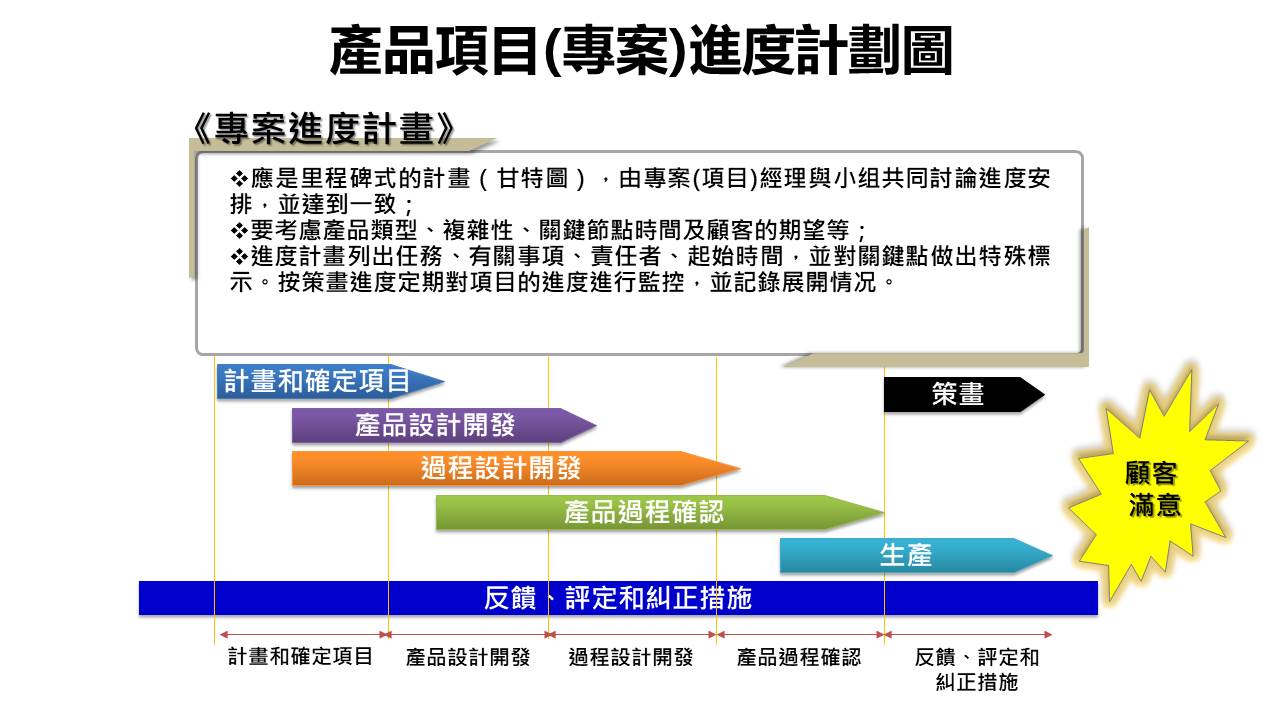
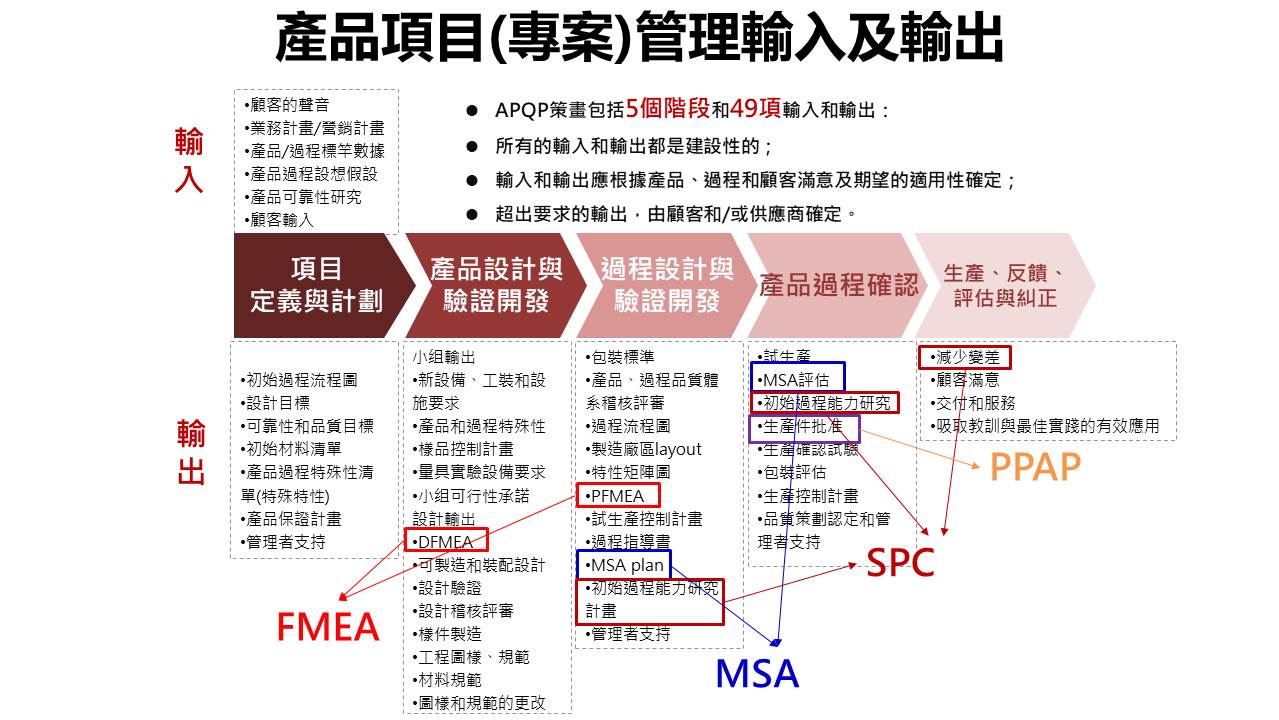
The progress of the project is shown in the figure below, and the corresponding inputs and outputs are also displayed simultaneously, while these five core tools are interspersed with a complete interpretation of the IATF16949 provisions (read more:Definition of IATF16949The project management methodology and tools should be implemented.
IATF 16949:2016The point:How are the six standard deviations enforced?
Six standard deviations, also known as six sigma (symbolised as "σ", pronounced "Sigma"). Tools and procedures for process improvement. In the automotive industry, "Zero Defects" has always been the ultimate goal of the automotive manufacturing industry and its related customers. To achieve these goals, including zero defective test escapes, zero repetitive problems, zero customer product breakage, and zero claims, tools and methods are needed to assist.
Of course, it does not mean that there must be no problems or defects in the process, but rather, through a number of control methods or analytical techniques to achieve early prevention and advance planning, from the problem or various optimisation processes to reduce failures and defects, to solve the customer's and their own problems, and to move towards the goal of zero defects.
In other words, companies that endeavour to implement the six standard deviations reduce variability, increase value and reduce costs, reduce waste and shorten cycle times, and in turn bring quality products and services to their customers, even exceeding their expectations.
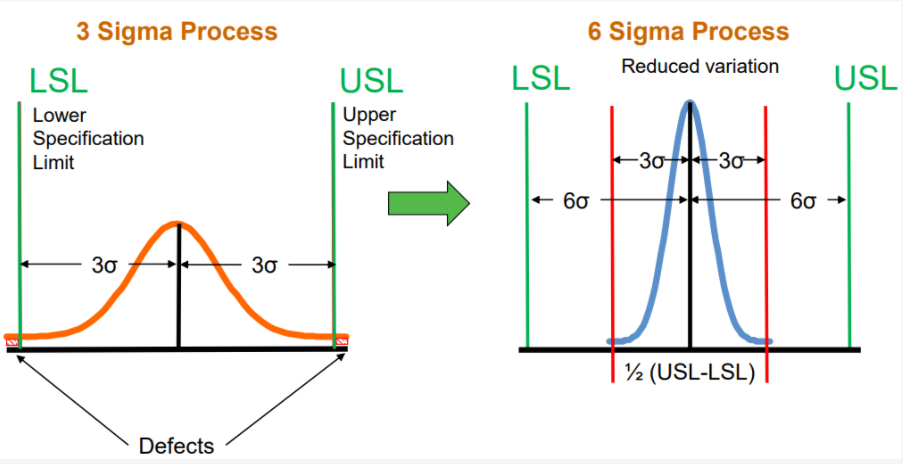
The definition of six standard deviations is the use of statistical methods, the process of statistical data modelling, such as the curve of the normal distribution and in the process between the average and the nearest specification limits reached six standard deviations, when through a variety of control and improvement of the manufacturing process to control the variability of the product characteristics or functions, fall within the six standard deviations, there are 99.99966% of the product is no quality problems (3.4 defects per million), so we can use the six standard deviations to calculate the percentage of products without defects. problems (3.4 defects per million), therefore, the six standard deviations can be used to calculate the percentage of defect-free products.
Simply put, Six Sigma means that 99.99966% of the products produced are free of quality problems (3.4 defects per million).
The concept of Six Standard Deviation was born in Motorola in the 1970s and combines a number of tools to reinforce this core idea, such as Total Quality Production Management (TPM), Zero Defects methodology, Quality Control, DMAIC methodology, DMADV or DFSS methodology, and of course a variety of complementary quality management tools, all working together towards this core goal. For example, Measurement System Analysis (MSA), Statistical Process Control (SPC), Why-Why analysis, Analysis of Variance (ANOVA), ANOVA, Fishbone Diagram Analysis, DOE, Plato Analysis, Quality Functional Development (QFD), Regression Analysis, SIPOC Analysis, Taguchi Analysis, and so on.
Recently due to Toyota's Lean Manufacturing approach - the core of which is to create maximum value from minimum work, the 1984 Production Philosophy (TPS), which aims to reduce unproductive waste in the production process. As a result, some people have combined the six standard deviation approach with the lean manufacturing method to create a management method called "Lean Six Standard Deviations".
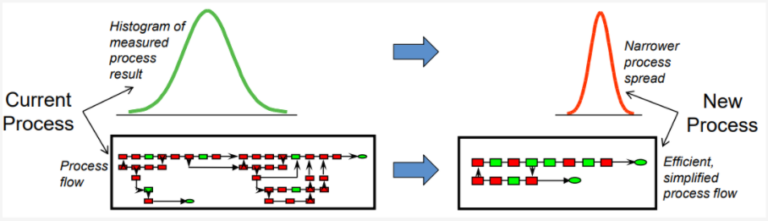
Simple cases of six standard deviations, or six standard deviations, can be found in Honeywell, GE, the world's top 500 companies.A glimpse into theMost of theFamous EnterprisesAll of them have already started to use the six standard deviation management method to cut costs and improve management quality.
For example, the timing of a restaurant's meal delivery can be aligned as closely as possible within the required timeframe to meet the needs of customers who want to enjoy a hot meal at a specific time;The apparel industry remainsClothes are made in the same size as far as possible.The customer will be able to measure his/her own body shape and clothing size;(math.) genusMobile Phone Brand GuaranteeEvery batch of mobile phones and lenses produce the same image quality.to gain the trust of our customers.(math.) genusThese examples(located) atproveThe six standard deviations have been implemented in all sectors.
The effective development of the corporate strategy and culture system structure, together with the level of risk management, and at the same time emphasise the methodical use of processes, zero defects, and customer-oriented requirements, to help the enterprise to grow profitably.