

The relevant clauses of the greenhouse gas standards are numerous and difficult for many learners to master. Therefore, before reading through each clause of ISO 14064, please refer to [the relevant document/reference needed].Five Steps to Obtain ISO 14064 CertificationTo gain a deeper understanding of the differences between carbon footprint and product carbon footprint, please click [link/link].Differences between 14064-1 and 14067 and Application Guidelines》。
Greenhouse gas and carbon footprint inventory standards: ISO14064-1, ISO14064-2 and ISO14067
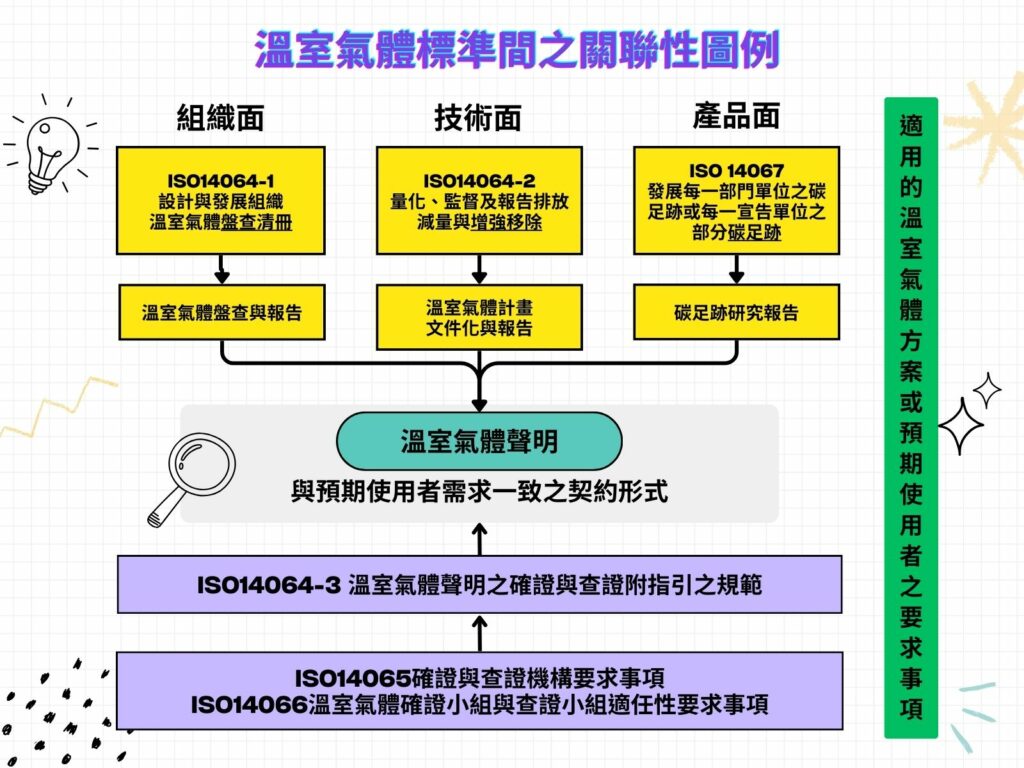
Before introducing the ISO14064 clauses, we have to explain the relationship between ISO14064-1, ISO14064-2 and ISO14067. The biggest difference between the three standards ISO 14064-1, 14064-2 and 14067 lies in their scope and purpose.
ISO 14064-1 focuses on the “organization,” which includes a company’s overall greenhouse gas emissions and how to standardize those emissions data to create a report called an “inventory.” The scope of this standard applies to “gate-to-gate” assessments, focusing on emissions within an organization.
ISO 14064-2 focuses on "projects" and evaluates a company's carbon reduction strategy, including the rationality of the strategy, expected results, and evaluation methods. This standard is assessed on a project-by-project basis, taking into account the overall organizational emissions.
ISO 14067 is concerned with "products". The standard quantifies the carbon dioxide emissions of products (which can be goods or services) throughout their life cycle and the impact they have on the environment. Depending on the characteristics of the product, the scope can be divided into "cradle to gate" for B2B or "cradle to grave" for B2C.
In fact, if a company’s Scope 1, Scope 2 and Scope 3 emissions are added together, this number is the company’s carbon footprint. The ISO 14000 series of standards have the same goal and concept, which is to "manage greenhouse gas emissions". What is not quantifiable cannot be managed, so different standards are only used to distinguish different categories and different management goals (inventory or emission reduction).
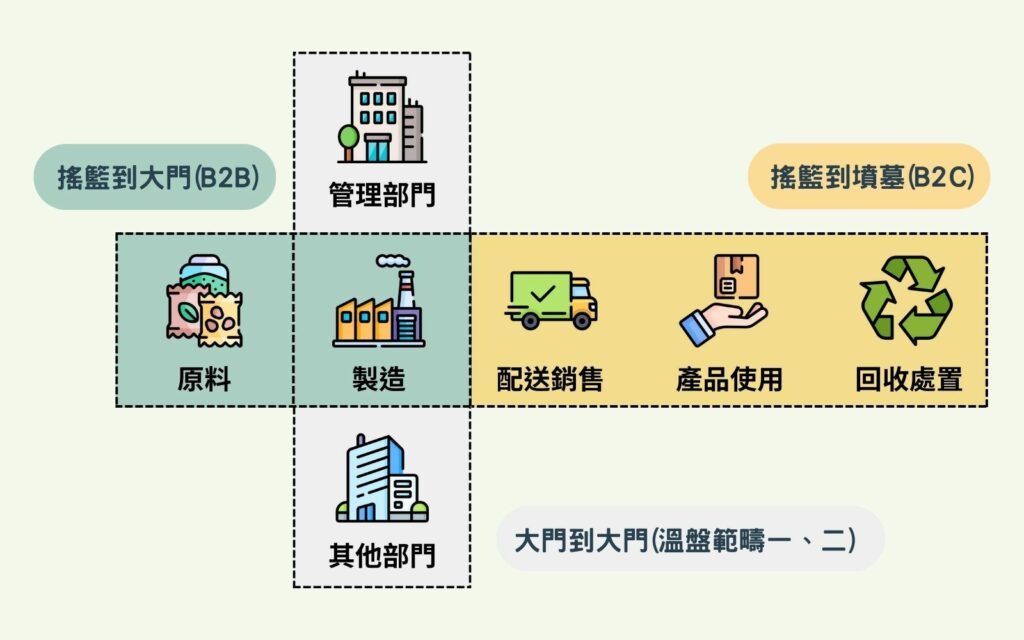
Another picture can be used to explain it more simply:
- ISO 14064-1 (2019.04) – Quantifying, monitoring and reporting emissions reductions and enhanced removals.
- ISO 14064-2 focuses on how organizations can quantify, monitor and report their emissions reduction measures and greenhouse gas removal enhancement measures, and evaluate their effectiveness.
- ISO 14064-3 (2019.04) – Specification for the verification and validation of greenhouse gas claims with guidance.
In addition, the ISO 14000 series of standards also specifies the verification and validation procedures for greenhouse gas emission statements and provides relevant guidance, such as:
- ISO 14065 – Requirements for assurance and verification bodies. This standard specifies the requirements that assurance and verification bodies must follow to ensure their independence, professionalism and integrity.
- ISO 14066 – Requirements for the competence of greenhouse gas assurance and verification teams.
- ISO 14067 – focuses on the product side, including the carbon footprint of the supply side.
In addition to carbon inventory, companies seeking to further reduce carbon emissions at their sources typically implement ISO 50001. It's worth noting that ISO 50001 aims to help organizations achieve greater energy efficiency, reduce energy consumption and waste, and lower related energy costs. It encourages organizations to establish, implement, maintain, and improve energy management systems to ensure effective energy use.
ISO 14064-2 focuses on the management and reporting of greenhouse gas reduction measures at a project level, while ISO 50001 focuses on overall energy management to improve energy efficiency and reduce costs.
Application of ISO14064 clauses: How should companies respond to greenhouse gas and carbon footprint inventory standards?
The following table can clearly show how the corresponding enterprises should respond:
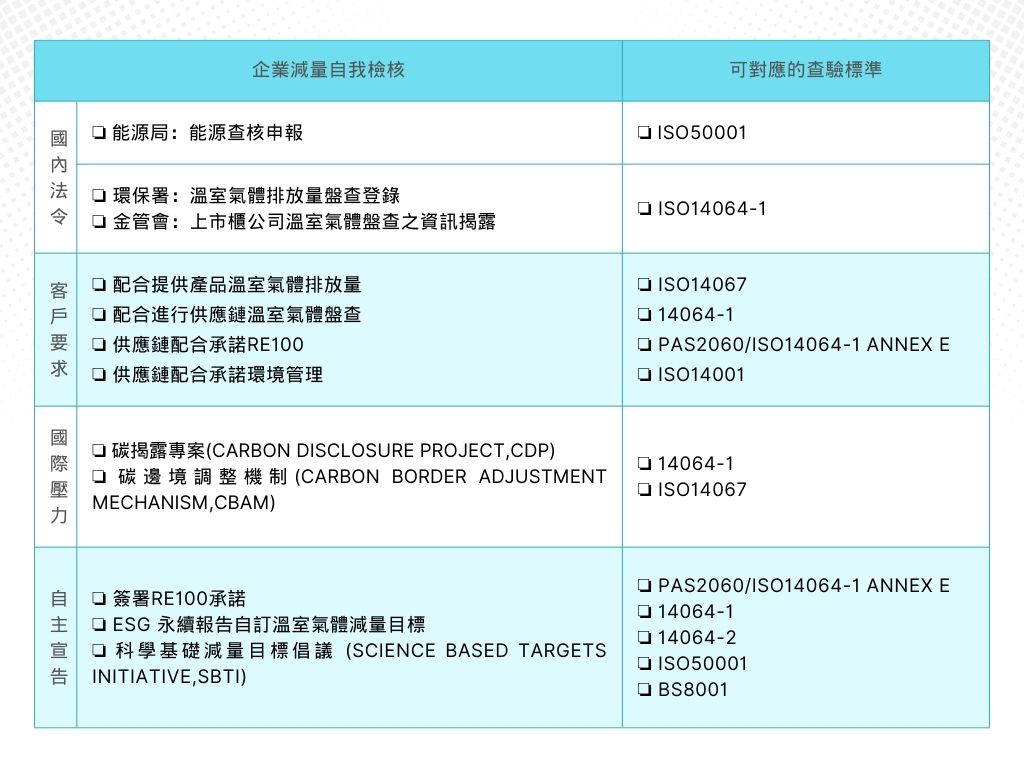
Generally speaking, ISO 14064-1 is the first ISO14064 clause that most companies are familiar with. After all, decision makers need to have a comprehensive understanding of the company's overall greenhouse gas emissions and how to standardize these emission data. Next is ISO 14067 on the product side, and further up is ISO 50001.
Therefore, in terms of measurement and reporting of ISO 14064-1, this part covers the requirements for measuring and reporting an organization’s greenhouse gas emissions, including scope and definition, inventory methods, recording and reporting of information, etc.
You can refer to the link provided by the Ministry of Environment: Calculation Tool – Business Greenhouse Gas Emissions Information Platform (moenv.gov.tw)
Core principles of ISO14064 standard
ISO 14064 clausesThe core principles of the standard are of paramount importance and include:
- The core principles of the standard are of paramount importance and include:
- Consistency: Ensure consistency in inventory results and methods across multiple years to allow for comparison and tracking of changes.
- Scope and definition: Clearly define the scope of the inventory, including emission sources and application areas, to ensure comprehensiveness.
- Records and Documents: Records and documents of the inventory are properly maintained and managed to demonstrate compliance and traceability.
- Comparing annual data: Allows organizations to compare the results of their audits across different years to assess effectiveness.
- Uncertainty Management: Assess and manage uncertainty in inventory data to improve accuracy.
- No impact on information: Avoid improper modification, tampering or manipulation of audit information to maintain integrity and reliability.
Mingzheng Consultant's Practical Notes: In our practical experience consulting with companies, the most common reason for verification failures is not incorrect "scope definition," but rather "outdated or mismatched emission factor references." We recommend that companies establish a standard operating procedure (SOP) to regularly update the source of emission factors annually at the beginning of the audit.
Key points for verification of ISO14064 clauses
Verification is a key step in ensuring that an organization's audit complies with the ISO 14064 standard. Highlights include:
- Verification definition: Verification is an independent assessment to determine the accuracy and compliance of an inventory report.
- Verification procedures: The verification procedures include document review, field visits, interviews, and report preparation.
- Type of verification: Internal verification is performed within the organization, while external verification is performed by an independent agency to provide greater credibility.
- Verification objectives: The verification objectives are to ensure that the audit complies with the requirements of the ISO 14064 standard and to provide a reliable audit report.
- Benefits of verification: Verification helps improve the quality and reliability of inventory, enhances compliance and traceability, and provides organizations with more climate transparency.
- Verification challenges: Verification can involve time, cost, and resources, and requires overcoming potential barriers such as data availability and uncertainty.
Recommended reading:
One-stop solution provider
Mingzheng Management Consultants give you the most professional guidance and verificationServe
The coaching consultant team includes industry executives, leading auditors of verification companies, industry lecturers, etc., with decades of experience.
Welcome to contact us in the chatbot at the bottom right, or click this phone number directly to call 0921058648!