
The new AIAG Core Tools have been officially released independently. Are you ready for your IATF 16949 audit in the face of these AIAG quality tool revisions?
In an environment of rapid global supply chain shifts, quality standards in high-end manufacturing are undergoing significant changes. The AIAG (Automotive Industry Action Group) has recently made substantial revisions to its core quality tools, among whichThe Control Plan (CP) was also issued independently for the first time..
Whether it's an automotive supplier preparing for an IATF 16949 audit, or a manufacturer attempting to upgrade from ISO 9001 to aerospace AS9100 to compete in the drone market, how can one understand the new standards and transition smoothly? This article will provide a comprehensive analysis for you.
I. New AIAG CP Released Independently: Analysis of the 4 Major Stages and "Safe Production" in the New Control Plan
The core aim of a Control Plan (CP) is to clearly define the control methods and characteristic parameters of a product at all levels such as system, sub-system, component, or material. In the major revision of 2024, the original three stages have been expanded toFour stagesWhen writing a CP, companies need to pay particular attention to the following differences:
- Prototype
- Definition: Dimensional measurements, material testing and performance testing during the sample manufacturing stage.
- Context: The car parts factory is testing the material strength of a new engine prototype to see if it meets the design specifications.
- Pilot production (Pre-launch):
- Definition: Tests conducted before mass production, and the reinforcement of various restrictions and controls begin.
- Context: Before mass production of electronic products, performance verification of the first batch of circuit boards under extreme environmental conditions.
- Safe Launch - Key focus areas for this revision:
- Definition: As a supplement to pilot production or full-scale mass production, implementEnhanced restrictions and controlsOn the form, you must tick both "Trial Production + Safe Production" or "Mass Production + Safe Production".
- Context: Conducting additional crash, extreme temperature, and longevity tests for new car models; or performing extreme operating tests of electronic equipment under high temperature and humidity, to ensure there are no safety concerns before official launch.
- Production
- Definition: Standard control plan for entering mass production.
2. Key Updates and Upgrades to APQP: Third Edition Enhances Risk Mitigation and Capacity Planning
The revision of APQP (Advanced Product Quality Planning), in addition to covering the 5 phases and approximately 48 inputs/outputs, further6 key performance indicators have been addedThis reflects the risk of supply chain disruptions brought about by geopolitical events and the pandemic in recent years. The standard requires companies to no longer just "bury their heads in the sand" but to have the ability to respond dynamically.
The newly added key inputs and outputs include:
- Initial Quality and JD Power Consumer Reports Feedback from market terminals to be included in advance.
- Production capacity planning (OEE) and change management: Assessing how to allocate effective production capacity for maximum benefit in environments with material shortages or rapid changes.
Risk Assessment and Mitigation Plan The R&D department needs to establish the concept of a second source (secondary supplier) for redundancy, enhance independent R&D capabilities, and form strategic alliances. For uncontrollable risks, companies must clearly explain the establishment mechanisms for response teams and war rooms during the APQP phase.
3. How can companies seamlessly adapt to the major revisions of the AIAG's Five Core Tools?
This revision of AIAG's tools places a greater emphasis on integration with VDA (German Association of the Automotive Industry) and full lifecycle data tracking. The revision status is summarised as follows:
| Core tools | Version status | Highlights and differences of the revised version |
| FMEA | 1st (AIAG-VDA) | Launching a new version in collaboration with VDA. |
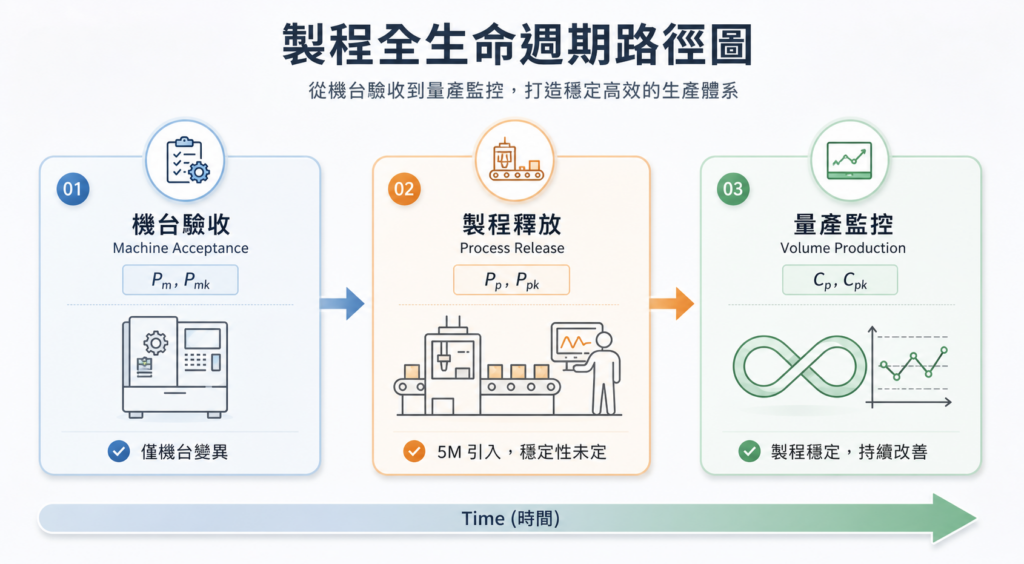
| SPC | 1st (AIAG-VDA) | Introducing the concept of the entire process lifecycleFrom initial pm/Pmk ➜ pp/Ppk ➜ mass production cp/Cpk. |
| APQP | Upgrade to 3rd | Strengthen production capacity management and supply chain risk mitigation. |
| PPAP | Uphold 4th | Currently unchanged. |
| MSA | Uphold 4th | Currently unchanged. |
| Control Scheme | Indie release | Separated from APQP and published as a standalone document, with the addition of the "Safe Launch" phase. |
Common challenges and coping strategies for businesses facing new standards:
The challenges companies most often face when encountering new versions of standards are not usually "changes in form formats," but rather "gaps in underlying understanding and theoretical foundations."
Many businesses, when facing new standards, often fall into the blind spot of "knowing what but not why".
- Over-reliance on packaged software and neglecting the essence of statistics: Most modern businesses have already implemented statistical software such as JMP and ANOVA, making it possible to produce data simply by pressing a button in practice. However, this has led many to neglect exploring the underlying logic. For instance, a common misconception is to treat "control limits" as a manually set fixed value, overlooking that they should be derived from the actual process variation. When the theoretical foundation is not solid, the generated reports will have a significant gap from the actual process capability.
- Interpretation of Core Concepts is Vague: The new version of the standard emphasises many concepts, but people often get stuck at the cognitive stage. For example: how should "safe production" in CP be understood and specifically implemented? And how should "risk" in APQP be systemically defined?
These theories are, to put it bluntly, not difficult to grasp. Just like obtaining the IATF external auditor certification, SPC and MSA both focus on assessing underlying theories, and then branch out from there. However, if companies attempt to figure things out internally, it often incurs significant trial-and-error costs. At this point, professional instructor guidance can quickly align the team's understanding.
From foolproof to system digitisation: An opportunity for quality control upgrades
Past quality thinking mostly stayed at "mistake-proofing (idiot-proofing)". With the revisions of SPC, APQP, and FMEA, quality control has officially enteredSystematisation and digitisationStatistical control and measurement system analysis for future manufacturing processes will rely more on systematic real-time monitoring of OOC (Out of Control) and OOS (Out of Specification), and will utilise the five properties analysis to ensure absolute process stability.
IV. Mingzheng Management Consultants: Providing comprehensive IATF16949 solutions
With the revision of SPC and APQP, quality control will increasingly rely on systematic real-time monitoring of OOC (Out of Control) and OOS (Out of Specification). Facing a gap in understanding, businesses require practical experience that can translate standards into tangible benefits.
Bright Proof Management Consultants have extensive experience in IATF 16949 consulting, offering companies comprehensive in-house training and revision gap analysis. Through systematic education and training, they strengthen the team's fundamental logical understanding, enabling them to easily handle high-level audits.
Contact Mingzheng Management Consultants immediately to secure your company's final step towards entering the high-end manufacturing supply chain!
One-stop solution provider