

Business management related coaching programs
Assisting with corporate performance management and internal communication
What is performance management by objectives?
A goal refers to an intangible or tangible stage-by-stage result, as well as the performance or behavior during the process of achieving it.
Performance refers to the behavioral manifestations of this outcome or process, and it is given a standard and criteria to measure the effectiveness.
Target performance is the evaluation and measurement of these results, and then the scope or range in which they are located is determined according to standards or criteria.
These, such as phased achievement goals or evaluation criteria, are components of performance objectives. To set goals or performance targets, one must first know how to generate an overall business strategy for the company or organization. A business strategy is similar to a policy, an organization's core values, and the various aspects derived from these core values.
The entire target performance management process can be divided into the following stages:
I. Analysis of Internal and External Issues
External issues include politics, economics, society, technology, and the natural environment; internal issues include operating conditions and corporate culture. These issues can generate risks or opportunities, which we call internal and external risks or internal and external issues.
II. Strategy Formulation
The formation of strategies comes from the analysis of internal and external issues, including related internal and external issues.
Based on an analysis of internal and external issues, an overall business strategy is formulated for a company or organization. This strategy is a guiding principle, the core value of an organization, and various aspects are derived from this core value. Commonly used analytical tools include SWOT analysis, Porter's Five Forces analysis, and TOWS strategy analysis, which are used to cross-analyze and formulate strategies. A business strategy must come first before goals or performance targets can be set.
III. Setting Goals and Performance
After a strategy is formulated, tools and methods are needed to assist in establishing and measuring the performance targets from strategy to objectives. These include strategy mapping, strategy solution matrix, and Balanced Scorecard analysis. When setting relevant performance targets, there are several ways to do so, such as Key Performance Indicators (KPIs), Management by Objectives (MBO), and Objectives and Key Results (OKRs).
Therefore, the entire goal-oriented performance management process, from the analysis of internal and external issues at the source and the formulation of strategies, to the analysis tools used to generate performance, and even how to set performance goals, requires many tools and methods to achieve.
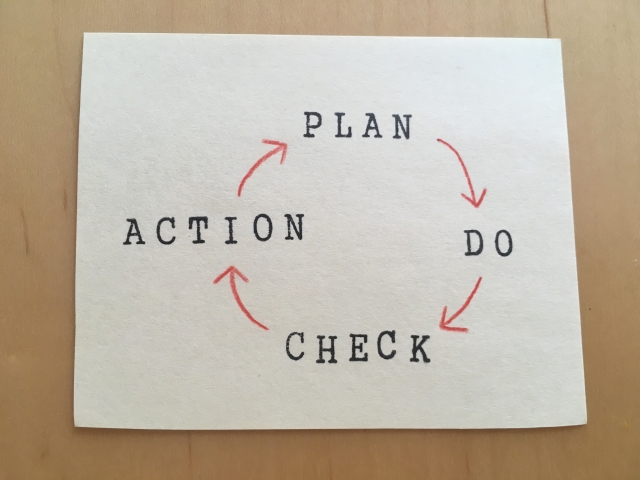
PDCA cycle
The PDCA cycle of system management is a management concept developed by Dr. W. Edwards Deming in 1950. It was initially applied to quality management, but it was extended to the management thinking and actions of all levels of the enterprise, and has become what it is today through continuous improvement.
This system architecture is structured in four main directions, with the PDCA cycle as the underlying mechanism.
Plan P
D (Do)
C. Check
Action A (Act)
The four-step process constitutes a series of goal management aimed at improvement and refinement.
Current situation analysis:
Consultants combine the strategies and directions of senior managers to understand the needs of the organization's internal structure (employees, culture, etc.) and external structure (government policies, etc.), analyze the current situation, and identify the causes of problems.
Draft a plan:
Develop a goal-oriented plan based on the causes. Establish goals, along with related directions and strategies.
Some risks need to be identified before implementation.

This is the part that takes up the most time in the entire process, and it is also the most important part.
- Original terms and quality system details
- Instruction manuals, procedure books, and guides are all available.
- Document review, revision, and issuance
- The system was fully implemented during the trial period.
The actual implementation of the target plan, and how to operate these measures.
This includes meeting market demands and cooperating with suppliers.
These discrepancies are examined and verified based on the execution results.
This includes audits and internal assessments, which also require checking internal responses to these management systems.
One key focus of the audit is the regular review of senior management.
Establish Standard Operating Procedures (SOPs), continuously improve and optimize them, and correct discrepancies to make the next plan even better.